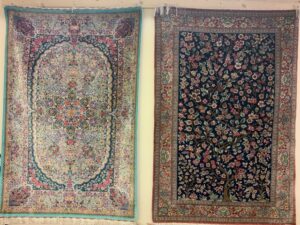
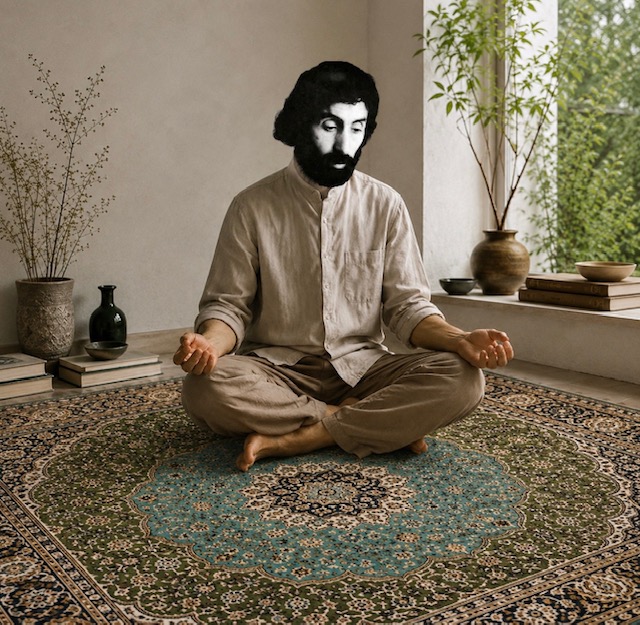
Meditation brings peace of mind and freedom of the soul. These same qualities are subtly embodied in the comfort, warmth, and softness of handmade Persian carpets. As the contemporary Iranian poet Sohrab Sepehri beautifully writes in The Traveller:
“Where is the place of arrival?
Where one may spread out a rug and sit upon it, free of care,
and listen to the sound of a pan being washed beneath a nearby tap.”
In these simple yet profound lines, the rug becomes more than a household object; it becomes a place of stillness, presence, and contemplation. It is a space where one pauses, becomes grounded, and reconnects with the quiet beauty of everyday life. In this sense, meditation and the Persian carpet naturally come together. Both invite us to return to the centre of our being, where silence, awareness, and inner peace unfold.
Another profound connection between handmade Persian carpets and meditation lies in the rhythmic chanting of the weaver during the weaving process. As the carpet gradually emerges, many traditional weavers sing repetitive melodies that accompany the colours and knots of the rug. Much like a mantra in meditation, these rhythmic chants create a state of concentration, tranquillity, and inner harmony. The spiritual intention of the weaver is thus woven into every row of knots, transforming the carpet into more than a handcrafted object—it becomes a vessel of mindful presence. In this sense, the meditative state is not only experienced by the person who sits upon the carpet, but is also embedded within its very creation.
The designs of handmade Persian carpets are deeply connected to meditation and the inner journey of self-discovery. One of the most celebrated motifs in Persian carpet design is the medallion. Appearing in a variety of forms, the medallion occupies the centre of the carpet, symbolising the centre of life and existence.
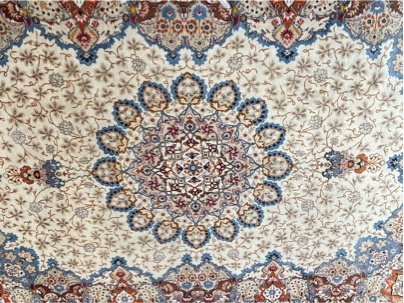
Likewise, in meditation we journey toward the core of our being, where the mind becomes silent and consciousness opens into infinity. At the heart of the medallion there is often a central point or a sun motif. The central point represents the experience of stillness and emptiness—the “point zero”—from which infinite possibilities emerge. The sun, radiating from the centre, symbolises illumination, wisdom, and the light of consciousness. This symbolism has deep roots in the ancient Persian philosophical tradition of Hekmat-e Khosravani (Ancient Persian Wisdom), in which light represents both knowledge and spiritual awakening.
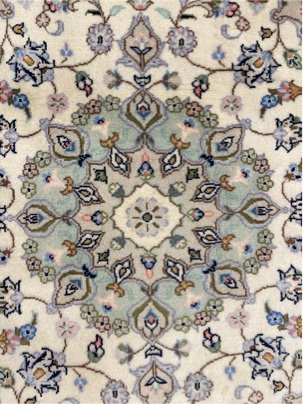
Surrounding the centre are harmonious motifs, often including flowers with eight petals, symbolising perfection, wholeness, and spiritual fulfilment. These then expand into a circle of sixteen petals (8 × 2), representing the dynamic interplay of light and shadow—the complementary forces that exist within every human being and throughout creation.
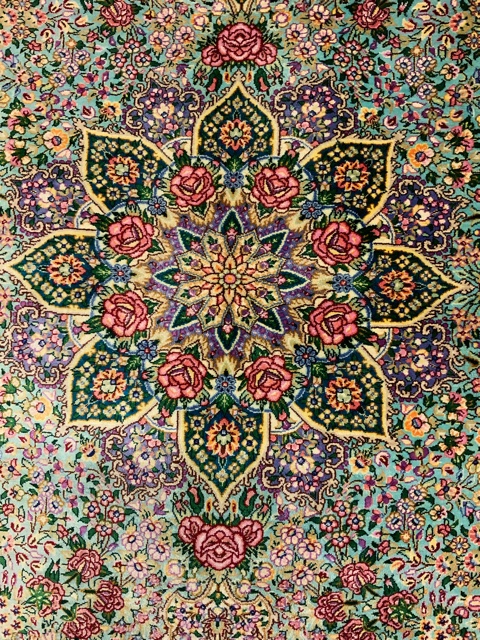
From there, the design unfolds into an abundance of flowers, leaves, vines, and arabesques. At first glance these patterns may appear repetitive, yet they are expressions of unity within multiplicity. Every motif is unique, while each contributes to a harmonious whole. The eye follows these flowing forms without reaching an end, gently drawing the viewer into a contemplative state in which finite forms become gateways to the infinite.
In this respect, the symbolic language of Persian carpet design bears a remarkable resemblance to Buddhist mandalas. Both employ sacred geometry and symbolic motifs that guide the observer inward, from the visible world to the invisible centre of consciousness. Rather than serving merely as decoration, these timeless designs function as visual maps of meditation, leading the mind beyond form and repetition toward silence, unity, and the experience of the infinite.
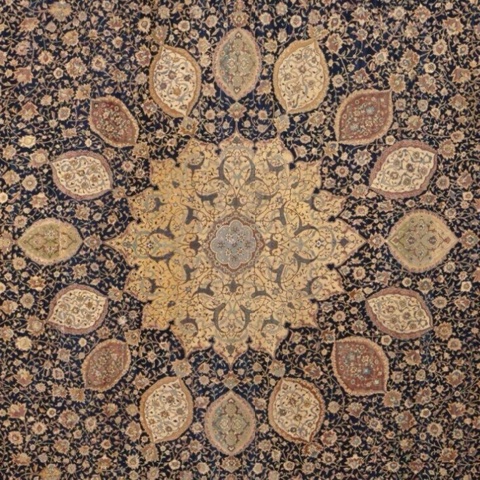
Ultimately, a handmade Persian carpet is more than a work of craftsmanship or an object of beauty. It is a woven philosophy—a sacred landscape that reflects humanity’s timeless search for harmony, balance, and transcendence. Like meditation itself, it invites us to dwell at the centre, where stillness becomes illumination and the ordinary reveals the eternal.