Introduction
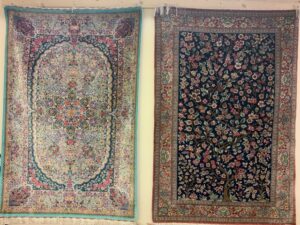
The Persian carpet is far more than a decorative textile or a functional floor covering; it is one of the deepest cultural, mythological, and cosmological expressions of Iranian civilization. Woven into the fabric of Persian carpets are narratives of ancient Iranian worldviews, cosmic order, ritual traditions, and the concept of the ideal garden. Many scholars of mythology, including Dr. Mehrdad Bahar, argue that the motifs of Persian carpets reflect symbolic structures and ancient cultural archetypes rooted in the religious beliefs, creation myths, and cosmological understanding of early Iranians.
Within this framework, the concept of the Persian Garden—or Pairidaeza (Paradise)—occupies a privileged place. Persian carpets may therefore be understood as symbolic recreations of the Persian garden within enclosed domestic spaces: silent yet vivid gardens that remain deeply connected to humanity’s cosmic consciousness.
The Mythological and Cosmic Origins of Persian Carpet Motifs
According to Dr. Mehrdad Bahar, the motifs found in Persian carpets were not designed merely for aesthetic beauty; rather, they carry symbolic meanings and embody the worldview of ancient Iranians. Medallions (toranj), corner motifs (lachak), multi-petaled floral designs, and geometric forms are frequently interpreted as symbols of the sun, the center of the universe, cosmic order, and the cycles of creation.
From this mythological perspective, the carpet is not merely a decorative object but a visual text that reflects profound concepts such as the order of existence, the connection between heaven and earth, and the continuity of life. Many geometric and abstract motifs preserved in tribal and rural carpets can also be understood as archetypes that have emerged from the indigenous beliefs of the Iranian plateau and have been transmitted across generations for thousands of years.
Trees, Gardens, and the Concept of Eternity in Persian Carpets
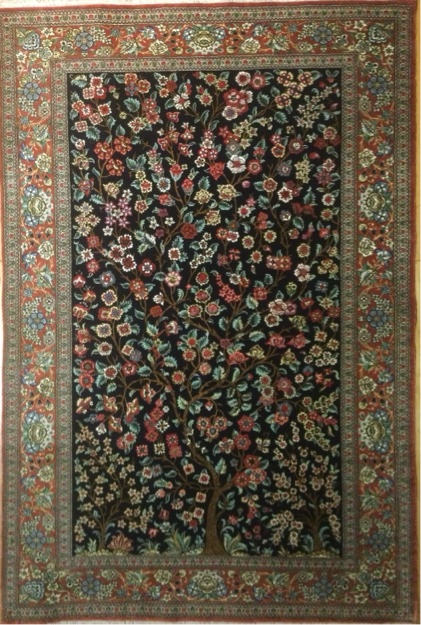
Among the most important symbolic elements in Persian carpet designs are the tree and the garden. In Iranian mythology, particularly in interpretations emphasized by Dr. Bahar, the cypress tree and the “Tree of Life” symbolize immortality, prosperity, and the connection between the earthly and celestial realms.
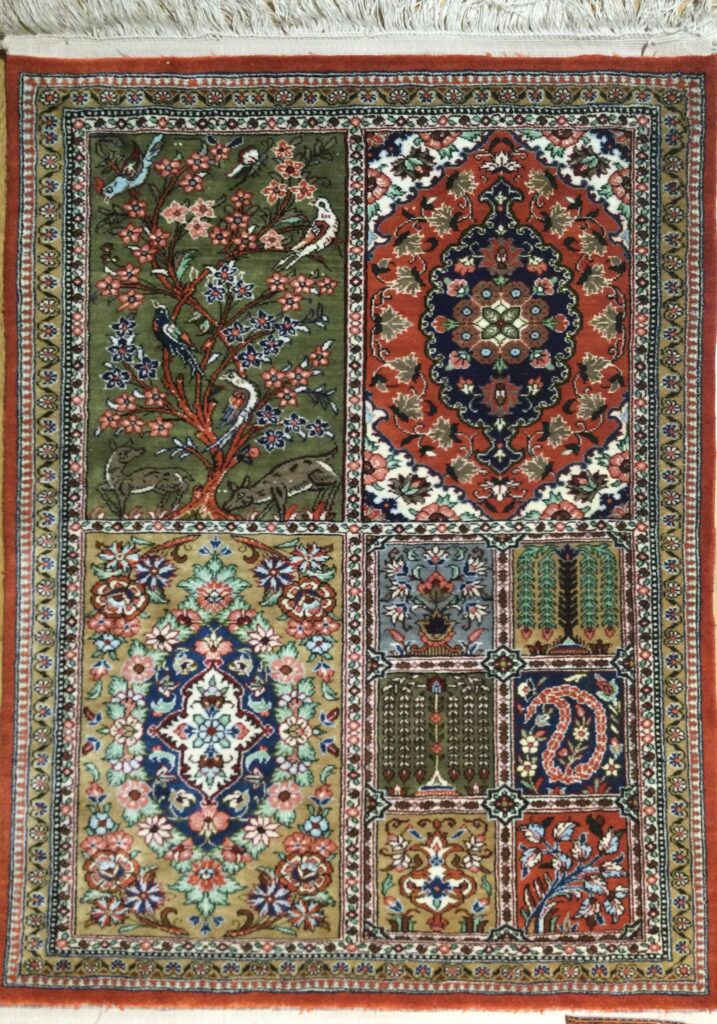
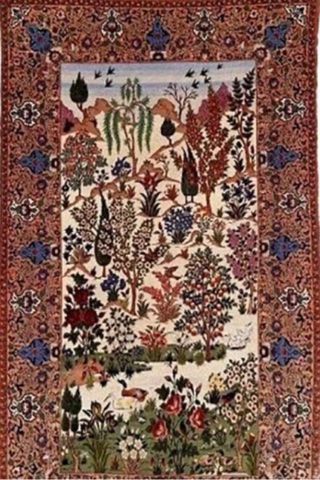
These motifs appear especially prominently in so-called “garden carpets” or Golestandesigns. The cypress tree, representing endurance and freedom, often appears alongside flowering and fruit-bearing trees that symbolize fertility and renewal. Together, they create a symbolic dialogue between eternity and rebirth, presenting the carpet as an image of an idealized natural order and cosmic harmony.
Pardise: The Ideal Garden in Iranian Thought
In ancient Iranian culture, Pardis—the origin of the modern word in English “Paradise”, in Aabic “Ferdos”—was not merely a recreational garden but a miniature representation of an ideal, sacred, and orderly universe. By constructing gardens, Iranians sought to recreate divine order on earth and align human living spaces with the structure of the cosmos.
In Iranian mythology, drought and barren deserts symbolize destructive demonic forces, whereas flowing water, lush greenery, and flourishing trees represent divine power and the triumph of life over death. Thus, bringing the image of the garden indoors through carpets was not merely decorative but constituted a ritual act intended to repel destructive forces and invite blessing and abundance.
The Reflection of the Chaharbagh Structure in Persian Carpets
Persian carpet designers directly incorporated the concept of Pairidaeza into carpet patterns, resulting in what are today known as “garden carpets” or Golestan designs. The geometric structure of these carpets clearly derives from the architecture of Persian gardens, particularly those of Pasargadae and the Safavid gardens of Isfahan.
The defining characteristic of this design is the Chaharbagh (“Four Gardens”) structure, in which the carpet field is divided into four major sections by intersecting waterways or channels. In Iranian symbolism, the number four represents the four cardinal directions, the four fundamental elements of life—water, air, earth, and fire—and the four seasons.
Within these divisions, flowing streams are depicted with motifs of fish, ducks, and water ripples. At the center of the carpet, a large medallion often symbolizes a pond or central reservoir—the heart of the garden and a focal point of life and balance.
The Baharestan Carpet: A Magnificent Recreation of Paradise
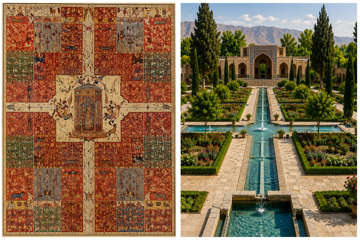
Among the historical masterpieces of Persian carpet art, the legendary Baharestan Carpet (also known as Spring of Khosrow) occupies a mythical position. Commissioned by Khosrow I Anushirvan, the Sasanian king, this carpet stands as one of the grandest attempts to recreate the ideal Persian garden within an enclosed architectural space.
Historical accounts suggest that winters in Ctesiphon, the Sasanian capital, were cold and barren. Consequently, the king ordered the creation of an enormous carpet so that, while seated in the great palace hall, he could experience the sensation of walking through a flourishing spring garden and momentarily forget the harshness of winter.
The carpet’s structure was explicitly modeled on the Chaharbagh system of Persian garden design. Historical sources, including al-Tabari’s chronicles, describe its astonishing splendor: its warp and weft were woven from silk, gold, and silver; its green background represented grassy meadows; flowing streams were rendered with pearls and precious gems; and fruits hanging from trees were depicted using jewels such as rubies and emeralds.
The exact dimensions of the Baharestan (Spring of Khosrow) carpet are unknown due to its destruction, but historical sources mention varying measurements. For example, in the History of al-Tabari, its length is reported as 450 cubits and its width as 90 cubits, while some other historical books cite dimensions of 140 meters by 27 meters. Additionally, in the book Did You Know? by Dr. Robert Bamban, the dimensions of this magnificent carpet are given as 26 meters by 24 meters. These discrepancies suggest that the reported measurements were estimates based on different observations or accounts, and none of them can be considered the definitive dimensions of the Baharestan carpet.
Although the origins of Persian garden design can be traced back to the Achaemenid period and the geometric gardens of Pasargadae, the idea of transferring the garden into an interior domestic setting through an ornate, jewel-encrusted carpet reached its height during the Sasanian era in the form of the Baharestan Carpet. Tragically, this unparalleled masterpiece was destroyed and divided as war booty following the fall of Ctesiphon during the early Islamic conquests.
The Relationship Between the Persian Garden and Cosmic Order
Some studies trace the origins of Persian garden geometry to ancient astronomical observations. Zoroastrian priests are believed to have used the North Star as a fixed celestial point for calculating stellar movement. They observed that the constellation Ursa Major rotated around the North Star throughout the year, occupying four principal positions that formed a cross-like geometric pattern.
From this perspective, the structure of the Persian Chaharbagh may be understood as a terrestrial reflection of celestial order—a sacred geometry inspired by the cosmos and translated into human environments. Such interpretations further illuminate the spiritual significance of the Persian garden and its enduring place in Iranian culture.
Conclusion
The Persian carpet may be regarded as a mirror of Iran’s historical, mythological, and cosmological memory—an artistic medium in which nature, religion, mythology, and architecture intertwine. The Persian garden, as a symbol of the ideal cosmic order, is recreated within the woven structure of the carpet and brought into the domestic sphere.
From this perspective, the Persian carpet is not merely an image of a garden but a symbolic host of the Persian garden: a silent manifestation of earthly paradise through which Iranians, informed by cosmic awareness, recreated harmony and sacred order within the spaces of everyday life.