Symmetry, Imperfection and the Persian Carpet
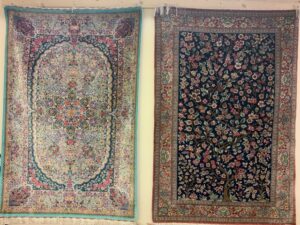
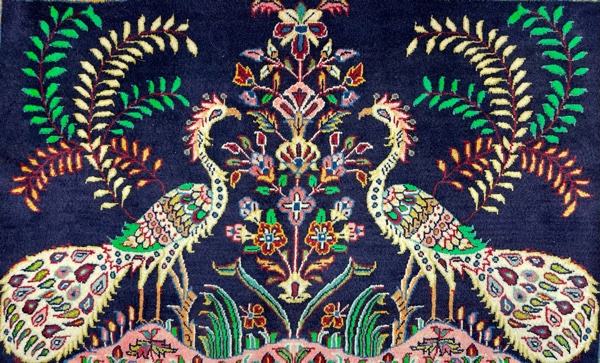
The renowned contemporary Persian poet Sohrab Sepehri is said to have observed that “the symmetry of a carpet is never perfect.” This idea points towards an important characteristic of Persian art: the apparent order and symmetry of a design do not necessarily depend upon mechanical or mathematical perfection. Rather, beauty may emerge from the subtle variations and imperfections introduced by the human hand.
One should perhaps not seek perfect symmetry, because perfect symmetry does not exist even in nature. As Jacques Nickel is quoted as recalling his father:
“What gives the carpets of the East their charm is that they have never been made completely symmetrical, although they may appear so.”
The Persian carpet takes us naturally towards the Persian garden—and, in a sense, the carpet itself has often served as a substitute for the garden. According to a well-known tradition, the Sasanian kings conceived the idea that even during winter they should not be deprived of the sight of a garden. A great carpet was therefore imagined and made in the form of a garden, reproducing its colours, pathways, water and vegetation.
The garden was far more than a place of beauty. It represented the universe and symbolised the ruler’s power over nature. In this sense, the idea expressed in the old Persian tradition that “a king without a garden is not a true king” acquires a deeper meaning: the garden was a representation of the ordered cosmos.
The symmetry of the Persian garden also resonates with mystical ideas. Water channels reflect and multiply the blue of the sky, while the garden itself becomes an earthly image of paradise. The Persian word pairidaēza, from which the word “paradise” ultimately derives, is associated with the idea of an enclosed garden. The garden therefore becomes both a physical space and a spiritual metaphor.
The same principle can be experienced in Persian mosque architecture. Symmetry surrounds the space of worship. Repeated forms, geometric patterns, inscriptions and architectural rhythms create a sense of order and contemplation. The worshipper moves through a world of multiplicity towards an awareness of unity.
Yet symmetry itself raises a paradox.
Symmetry is the division of unity. It speaks simultaneously of duality and multiplicity.
But in duality, the two things are not necessarily identical. Place a mirror opposite a cup: the image appears to be another cup, yet the reflection ultimately reveals the presence of a single object. The image is separate and yet inseparable from its source.
This idea of reflected unity has profound parallels in Persian mystical thought. In the story of Attar’s Conference of the Birds, the Simurgh discovers the reflection of unity in the mirror of existence. Likewise, the story of Narcissus, gazing into the water, can be understood as an encounter with the reflected image of the self and, ultimately, with the solitary essence of one’s own being. Religious art has long drawn upon this relationship between the original and its reflection.
Throughout the minor arts of Persia, parallel forms and symmetrical relationships appear repeatedly—in embroidery, engraving, inlay work, illumination and architecture. They also appear in poetry, where symmetry becomes not merely visual but conceptual.
Consider the Persian ghazal. The two hemistichs of a couplet can be imagined as the two pans of a balance, while the couplet itself becomes a perfectly balanced scale. On one pan sits the moth; on the other stands the candle. They are different, yet their relationship gives meaning to both. This is conceptual parallelism: two images placed opposite one another, creating a third meaning through their relationship.
This art of parallel imagery reaches remarkable heights in the Indian style of Persian poetry. Sa’ib, for example, writes:
“Do not expect generosity from the aged world;
When the jug grows old, it gives no moisture back.”
Here the world becomes the counterpart of the old jug. Both share the quality of old age, and both possess the nature of retaining what is within rather than giving it back.