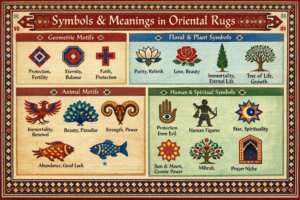
The Music of Colour and the Weave of Sound: Art, Psychology, and Cultural Memory
Human cultures have long understood that music, colour, and textile weaving are deeply connected forms of expression. Though they belong to different senses — sound, sight, and touch — they often function together as systems of rhythm, emotion, symbolism, and memory. Across civilizations, weaving has been described as “visual music,” while music itself has been imagined as a woven fabric of tones and rhythms unfolding through time.
This relationship appears in philosophy, psychology, ritual traditions, visual art, and even neuroscience. Whether in the geometric textiles of the Andes, the symbolic colours of ceremonial cloth, or the synesthetic visions of modern artists, the connection between colour, sound, and woven pattern reveals a shared human desire to organize experience into harmony and meaning.
Music and Weaving as Parallel Arts
Music and weaving are structured through remarkably similar principles. Both rely on repetition, variation, rhythm, layering, and tension.
In music, rhythm organizes sound across time. Melodies repeat and evolve, harmonies overlap, and contrasting tones create emotional movement. In weaving, repeated threads organize colour and form across space. Patterns emerge through the crossing of warp and weft, producing visual rhythms that can be simple or highly intricate.
A woven textile can resemble a musical composition:
- recurring motifs function like refrains,
- colour transitions resemble tonal shifts,
- layered patterns mirror harmony or counterpoint.
Even the process of weaving carries musical qualities. The repetitive movement of the loom resembles percussion, while the sequence of patterns often follows rhythmic cycles. In many traditional cultures, weaving is accompanied by singing or chanting, allowing bodily movement, memory, and rhythm to synchronize.
Many societies do not sharply separate artistic disciplines. Song, weaving, dance, dyeing, ritual, and storytelling often belong to one integrated cultural system. Art becomes not an isolated object but a living expression of communal identity.
The Psychology of Colour
Colour has profound psychological and emotional effects. Across cultures, colours are associated with emotions, seasons, ceremonies, spiritual energies, and social meanings.
Warm colours such as red, orange, and yellow tend to evoke energy, warmth, celebration, passion, and movement. Cool colours such as blue, green, and violet are often associated with calmness, introspection, spirituality, and reflection. Neutral tones such as black, white, grey, and brown frequently symbolize balance, mourning, purity, earthiness, or wisdom.
These emotional associations parallel the emotional qualities of music. Bright orchestral passages may feel “golden” or “warm,” while minor harmonies may evoke “blue” or darker emotional atmospheres. Even in ordinary language, people describe music using colour terms:
- bright tones,
- dark harmonies,
- warm sounds,
- blue moods.
Colour and sound therefore function as emotional languages capable of shaping perception and memory.
Colours and Musical Notes
Throughout history, artists and philosophers have attempted to connect musical notes with colours. Although no universal system exists, many symbolic correspondences compare the seven notes of the musical scale with the seven colours of the visible spectrum.
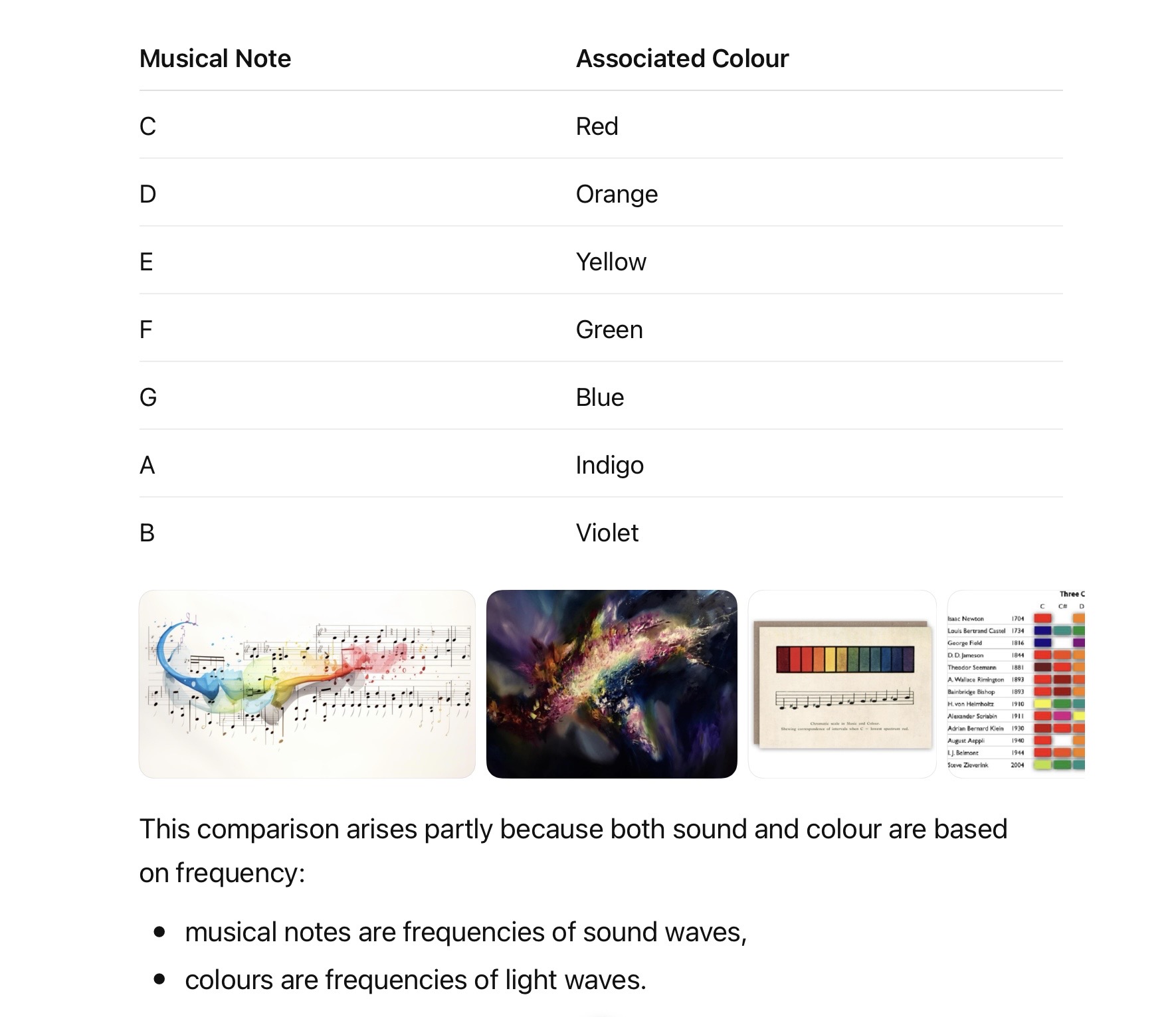
Though scientifically distinct, both systems organize vibration into perceptible patterns. This similarity inspired many thinkers to imagine hidden harmonies linking sound, colour, geometry, and emotion.
Synesthesia and the Blending of the Senses
Screenshot
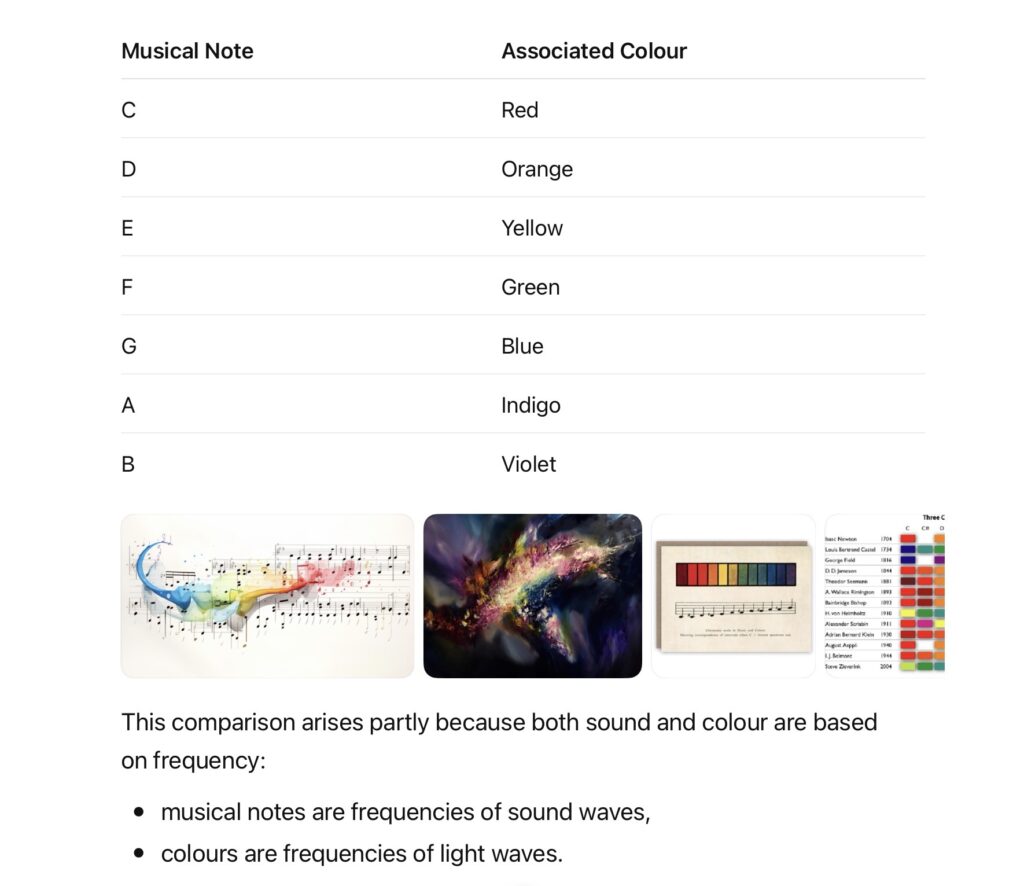
Some individuals experience a neurological phenomenon called Synesthesia, in which one sensory experience automatically evokes another. A person with synesthesia may hear colours, see sounds, or associate musical keys with visual forms.
For such individuals:
- a trumpet note may appear gold,
- a violin melody may produce flowing blue shapes,
- a musical key may possess a fixed colour identity.
The painter Wassily Kandinsky believed that colour and music shared emotional vibrations. He compared yellow to the sound of a trumpet and deep blue to the resonance of an organ. His abstract paintings sought to function like musical compositions, using colour relationships to create rhythm and emotional movement.
Similarly, the composer Alexander Scriabin experimented with “colour music,” designing orchestral performances accompanied by coloured light projections. Another composer, Olivier Messiaen, described specific harmonies and chords in vivid colours, integrating these perceptions into his compositions.
These experiments reflected a broader artistic belief that sound and colour are parallel forms of vibration capable of shaping human consciousness.
Colours as Notes, Weaves as Compositions
The relationship between colour and musical notes can be understood metaphorically.
A single colour resembles a single note:
- each possesses frequency,
- each carries emotional character,
- each gains meaning through relationship with others.
Similarly, weaving resembles musical composition.
| Weaving Element | Musical Equivalent |
| Thread | Note |
| Yarn texture | Instrument timbre |
| Repeated motif | Musical refrain |
| Warp and weft | Rhythm and harmony |
| Pattern variation | Musical development |
| Loom tension | Harmonic tension |
| Finished textile | Completed composition |
A textile composition therefore operates like a symphony in visual form. Contrasting colours create tension and release much like dissonance and harmony in music. Repeating patterns establish rhythm, while symmetrical designs resemble structured musical forms such as fugues or canons.
The compositions of Johann Sebastian Bach are often compared to woven structures because multiple melodic lines interlace with mathematical precision, much like threads crossing within a loom.
Cultural Traditions Linking Music and Weaving
Andean Traditions
In the Andes of Peru and Bolivia, textiles preserve cosmology, ancestry, and collective memory. Geometric woven patterns correspond closely with ceremonial rhythms performed on panpipes and drums.
The cyclical repetition found in both weaving and music reflects agricultural cycles, spiritual beliefs, and communal identity.
West African Traditions
In Ghana and neighbouring regions, kente weaving traditions connect colour symbolism with drumming, storytelling, and royal identity.
Each colour carries meaning:
- gold may symbolize royalty,
- blue harmony,
- red sacrifice or strength.
The rhythmic repetition of woven patterns parallels the layered structures of traditional drum ensembles.
Diné (Navajo) Traditions
Among Diné communities in United States, weaving reflects sacred balance, harmony, and cosmological order.
Geometric designs echo ceremonial chants and spiritual structures. Songs, rituals, and textiles together maintain cultural continuity and relationships with the natural world.
Indian Traditions
In India, classical musical systems connect melody, mood, season, and colour through the concept of raga.
Textile colours often correspond with festivals, deities, emotions, and times of day. Music, poetry, dance, and weaving historically evolved together within courtly and temple traditions.
Weaving Memory Through Sound and Colour
Music preserves memory through rhythm and melody, while textiles preserve memory through pattern and colour. Both can encode ancestry, spirituality, social status, and historical experience.
A melody unfolds through time as threads unfold through space. One is heard; the other is seen and touched. Yet both are forms of organized vibration transformed into emotional experience.
The enduring relationship between music, colour, and weaving reveals a fundamental truth about human creativity: the senses are not isolated systems but interconnected pathways through which cultures shape meaning and identity. Sound can become colour, colour can become pattern, and pattern can become memory. Through weaving and music, humanity transforms rhythm into culture and vibration into art.