The Pazyryk Carpet: The Oldest Rug in the World, a Testament to the Splendor of Persian Art
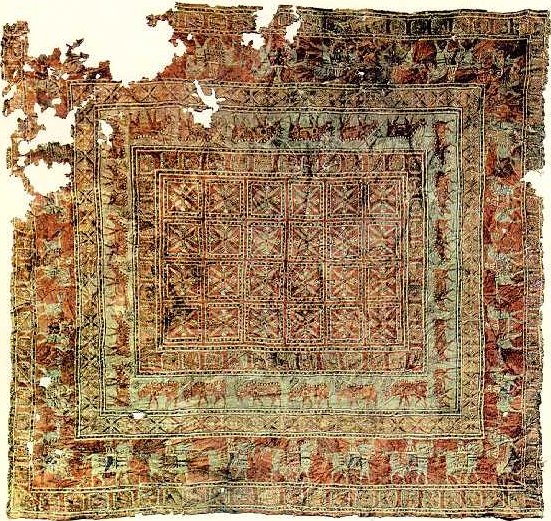
Deep within a frozen valley of the Altai Mountains in Siberia, among the ice-covered tombs of the Scythian people, a hidden treasure lay that would transform the history of world art. In 1949, Russian archaeologist Sergei Rudenko, during excavations of the Pazyryk burial mounds, discovered a carpet whose colors and patterns remained vivid even after 2,500 years. This masterpiece—known today as the Pazyryk Carpet—is the oldest known carpet in the world, and it remains an eternal symbol of Persian weaving artistry.
This carpet is not merely a textile; it is a historical document reflecting Iran’s place in the birth of civilization, aesthetics, and ancient craftsmanship. Within its warp and weft lies the philosophy of a people who wove history with their own hands.
Discovery in the Frozen Tomb of Pazyryk
In 1949, in the Pazyryk Valley of the Altai Republic in southern Siberia, a team of Soviet archaeologists excavated the frozen burial mounds of the Scythians.
In one of these tombs—alongside a chariot, sacrificed horses, and golden artifacts—they found a finely woven wool carpet.
Thanks to the permafrost conditions, the carpet had been perfectly preserved, and today it is recognized as the oldest surviving carpet in the world.
The Pazyryk Carpet is now housed in the Hermitage Museum in St. Petersburg and is regarded as one of the most important works in the history of global art.
Technical and Artistic Features
The Pazyryk Carpet is square, measuring approximately 1.98 × 1.83 meters.
It is woven from fine, durable wool, with an astonishing knot density of about 3,600 knots per square decimeter—a remarkable figure even by modern standards.
Its colors—red, yellow, green, blue, and brown—were derived from natural plant dyes. The harmonious, warm palette reflects the Persians’ sophisticated understanding of color balance and symmetry.
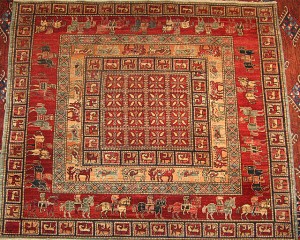
The central design features geometric panels and rows of animals and horsemen, all composed with mathematical precision and rhythmic order—evidence that the art of carpet weaving had reached an advanced stage at that time.
Design and Symbolism
Along the outer border of the Pazyryk Carpet, there is a procession of 24 deer in motion—symbols of nature, life, and continuity.
The next border depicts horsemen wearing Persian-style helmets, some mounting their horses and others leading them on foot—perhaps part of a ritual or royal ceremony.
The central field displays symmetrical geometric motifs inspired by Persian architecture and textiles.
This repetition and harmony are not only aesthetic but also philosophical, representing the cosmic order central to ancient Iranian thought: a universe governed by balance between earth and heaven, law and order.
The Persian Origin of the Carpet
Although the Pazyryk Carpet was discovered in Siberia, all archaeological and technical evidence points to a Persian origin.
First, the weaving technique is the symmetric Persian knot, not the asymmetric Turkish knot.
Second, the horsemen’s attire, the garments, and even the horse saddles correspond closely to Achaemenid art, especially the reliefs at Persepolis.
For these reasons, most scholars believe that the Pazyryk Carpet was woven in a Persian workshop, likely in Media or the Iranian Plateau, and later traded or gifted to the Scythians.
Connection with Achaemenid Art
In style and spirit, the Pazyryk Carpet reflects the essence of Achaemenid art.
The geometric order, rhythmic repetition, and perfect symmetry seen in the carpet are all hallmarks of Achaemenid aesthetics—from the stone reliefs of Persepolis to jewelry and textiles of the same era.
Even the depiction of the horsemen, with their distinct Persian helmets and robes, suggests that the carpet was either commissioned by the Achaemenid court or inspired by its artistic tradition.
Symbolic Meaning of the Carpet
In Persian tradition, a carpet is not merely a floor covering—it is a symbolic image of the cosmos.
The central medallion represents the axis of the world, while the borders form the walls that protect the universe from chaos.
In the Pazyryk Carpet, the circular arrangement of animals and riders symbolizes the cycle of life and eternity.
In essence, this carpet is a woven image of the Zoroastrian worldview—a vision of balance, order, and eternal motion between opposing forces.
Scientific Research and Preservation
Over recent decades, the Pazyryk Carpet has undergone numerous scientific examinations.
Microscopic scans have revealed the precision of the spun wool fibers, and chemical analyses at the Hermitage Museum showed that the main red dye was derived from Iranian madder (Rubia tinctorum)—further proof of its Persian origin.
A controlled refrigeration system in the museum prevents fiber decay, and a 3D digital model of the carpet has been created for research purposes.
Cultural and Global Significance
The Pazyryk Carpet is not only the oldest carpet in the world but also the earliest tangible evidence of Persian carpet weaving.
It demonstrates that centuries before Christ, the Persians had elevated the art of weaving beyond function—transforming it into a symbolic and spiritual expression.
In 2010, UNESCO inscribed Persian carpet weaving on the Representative List of the Intangible Cultural Heritage of Humanity, citing the Pazyryk Carpet as the earliest historical witness of this tradition.
Influence on Contemporary Art
The Pazyryk Carpet has inspired countless modern Iranian artists.
From contemporary carpets woven in Kerman and Tabriz, to miniature paintings and modern artworks, the spirit of Pazyryk continues to flow through the fabric of Iranian culture.
This carpet reminds us that Persian beauty is timeless—even if it lies buried in ice for millennia, it never fades.
Conclusion
The Pazyryk Carpet is not merely the oldest carpet in existence; it is the voice of history—the voice of hands that, in the cold of antiquity, wove the eternal warmth of culture.
In its motifs lives the philosophy of order and life, and in its colors burns the flame of vitality.
Like Iran itself, the Pazyryk Carpet is born of the earth and eternal in time—a testament that Persian art has neither beginning nor end, but flows eternally with the rhythm of the universe.
Source: https://tarikhema.org/subject/archaeology-subject/183989/the-pazyryk-carpet-the-worlds-oldest-rug-and-the-glory-of-persian-art/