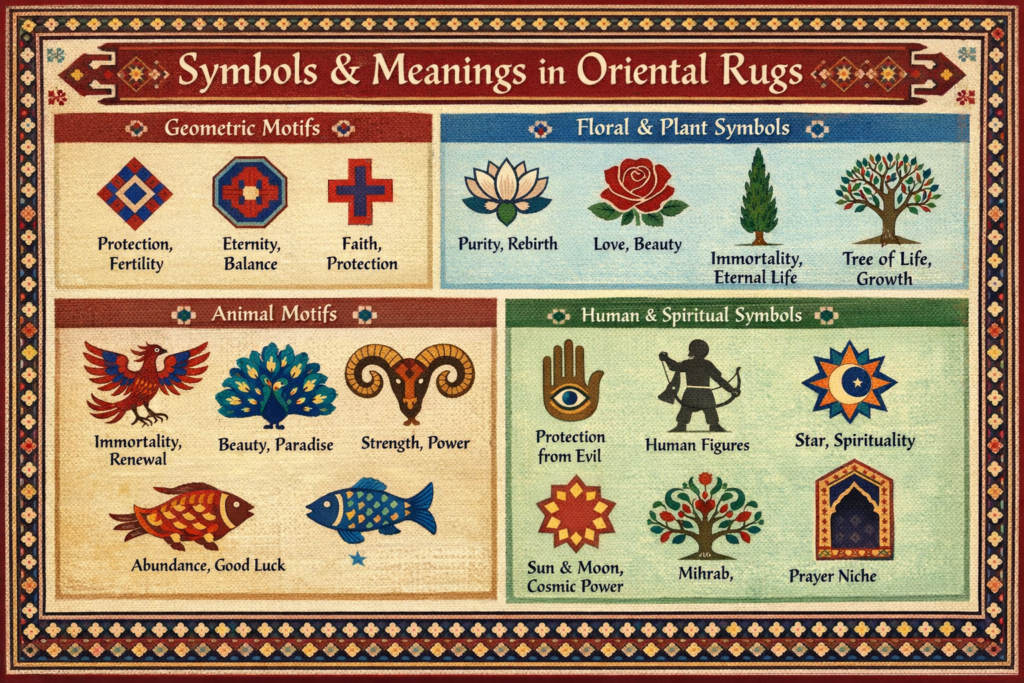
Oriental rugs are rich in symbolism, and their motifs often reflect cultural, religious, and regional beliefs. The exact meaning can vary depending on the origin—Persian, Turkish, Caucasian, or Central Asian—but there are common symbols across many types of Oriental rugs. Here’s a detailed overview:
1. Geometric and Abstract Symbols
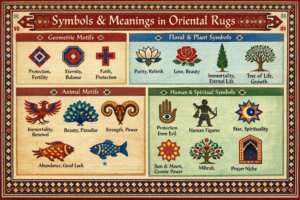
- Diamond: Often represents protection, a female element, or fertility. In some regions, it’s also a symbol of the evil eye’s protection.
- Hexagon/Octagon: Can signify eternity, balance, or the cosmic order.
- Crosses: Often protective, sometimes symbolizing four directions or faith.
2. Floral and Plant Motifs
- Lotus or Palmette: Symbol of purity, rebirth, and spirituality.
- Rose: Love, beauty, and sometimes divine grace.
- Cypress Tree: Immortality, eternal life, or connection between heaven and earth.
- Vine/Tree of Life: Represents growth, life, and immortality; a central theme in Persian rugs.
3. Animal Motifs
- Birds:
- Phoenix or mythical birds: Resurrection, immortality.
- Peacock: Beauty, pride, and paradise.
- Ram’s Horns: Strength, masculinity, and power.
- Fish: Abundance, prosperity, and good luck.
- Camel or Horse: Endurance, travel, and survival.
4. Human and Figurative Symbols
- Human figures: Sometimes depict daily life, hunting, or love stories.
- Hands or Eye motifs: Protection from evil, blessings, or guidance.
5. Religious and Spiritual Symbols
- Star: Guidance, spirituality, or the universe.
- Moon and Sun: Cosmic balance, time cycles, and divine power.
- Mihrab (prayer niche) patterns: Found in prayer rugs, representing the direction of Mecca.
6. Common Patterns by Region
Persian rugs—particularly from regions like Kashan, Isfahan, and Tabriz—are famous for their intricate symbolism:
- Numerological symbols in medallion designs – Central medallions and their surrounding motifs often reflect sacred or culturally significant numbers, creating balance and harmony in the design.
- Floral designs – Roses, lotuses, and palmettes symbolize beauty, purity, and spiritual rebirth.
- Curvilinear patterns – Flowing, interconnected designs represent infinity, continuity, and the interconnectedness of life.
- Tree of Life motif – A central theme representing growth, immortality, and the connection between heaven and earth.
These rugs combine artistic elegance with symbolic meaning, making them both visually stunning and culturally rich artifacts.
- Turkish rugs (Anatolian): Bold geometric patterns with stars, medallions, and ram’s horns.
- Caucasian rugs: Strong geometric motifs, stylized animals, and tribal symbols.
- Central Asian rugs—especially from Turkmen and Uzbek regions—motifs carry very specific tribal and protective meanings:
- Repeating gul motifs – Often represent clan identity; each tribe has distinctive gul patterns.
- Camel foot / Elephant foot – Symbolizes endurance, strength, and sometimes a connection to the domestic animals that sustain life. In Pakistan and India, the “elephant foot” motif reflects similar meanings.
- Goat horn (ram’s horn) – Strength, masculinity, and protection.
- Birds / Peacock – Beauty, paradise, and sometimes vigilance or spiritual guidance.
- These motifs often combine geometric repetition with animal or plant symbolism to offer protection, identity, and blessings, making each rug not just decorative but also culturally meaningful.
- If you want, I can make a visual chart specifically for Central Asian rug motifs, showing all these symbols with their meanings. It would be like a mini-legend for Turkmen, Uzbek, and related rugs. Do you want me to do that?
Tips for Interpretation
- Context matters: The same symbol may mean protection in one region and fertility in another.
- Colors add meaning: Red may signify courage, blue protection, green fertility or paradise, and white purity.
- Repetition is symbolic: Many motifs repeated in a border or field are meant to multiply blessings or protection.
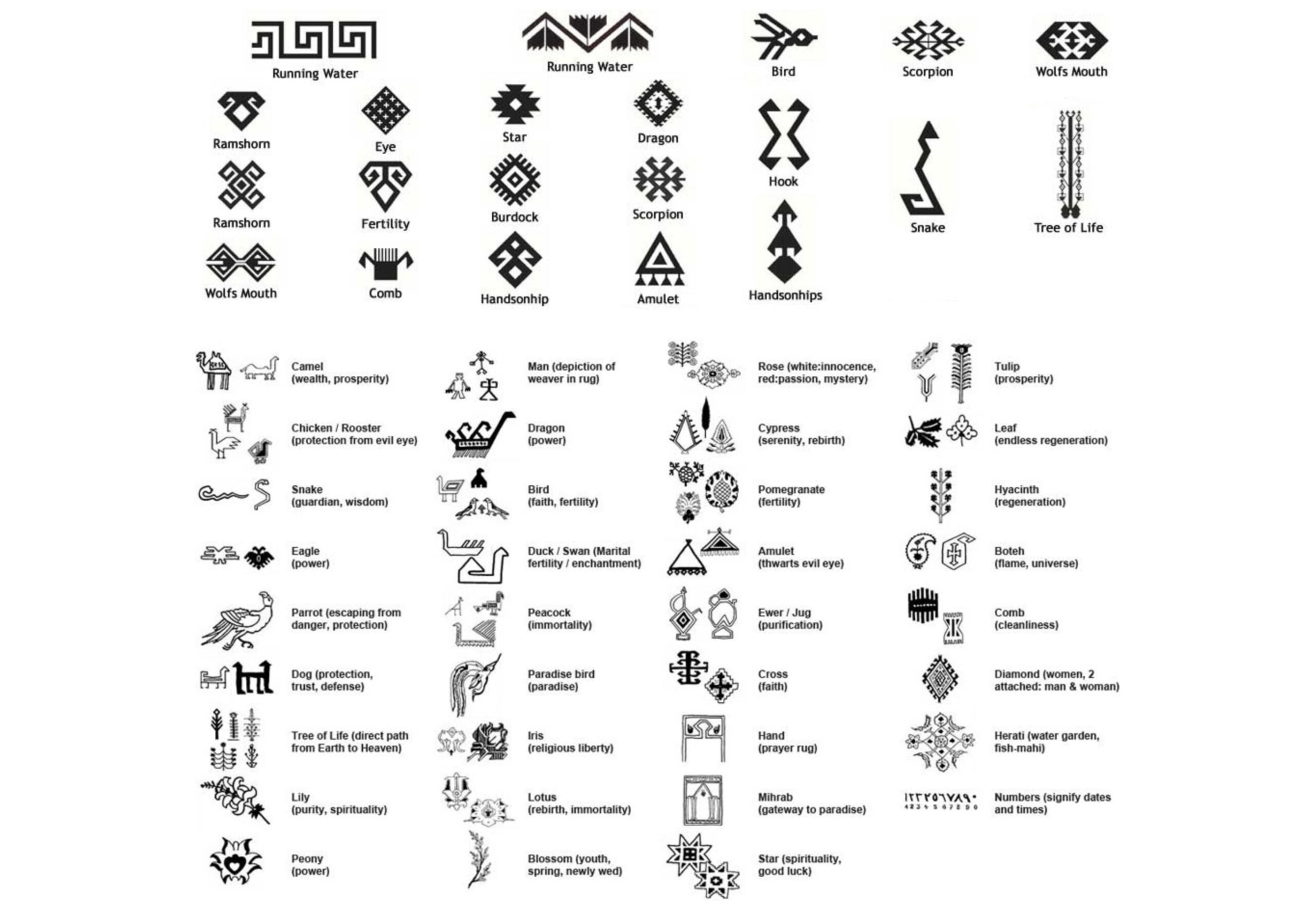
Here are a chart of some motifs with their meanings: